.
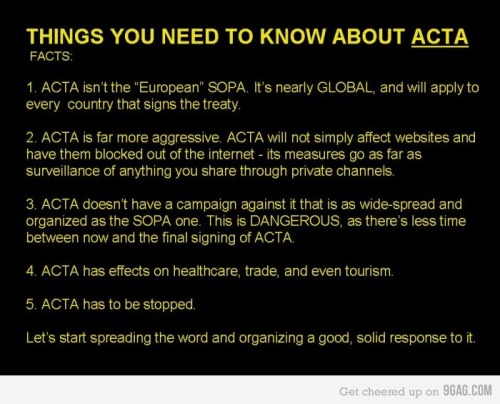
ACTA in a Nutshell –
What is ACTA? ACTA is the Anti-Counterfeiting Trade Agreement. A new intellectual property enforcement treaty being negotiated by the United States, the European Community, Switzerland, and Japan, with Australia, the Republic of Korea, New Zealand, Mexico, Jordan, Morocco, Singapore, the United Arab Emirates, and Canada recently announcing that they will join in as well.
Why should you care about ACTA? Initial reports indicate that the treaty will have a very broad scope and will involve new tools targeting “Internet distribution and information technology.”
What is the goal of ACTA? Reportedly the goal is to create new legal standards of intellectual property enforcement, as well as increased international cooperation, an example of which would be an increase in information sharing between signatory countries’ law enforcement agencies.
Essential ACTA Resources -
- Read more about ACTA here: ACTA Fact Sheet
- Read the authentic version of the ACTA text as of 15 April 2011, as finalized by participating countries here: ACTA Finalized Text
- Follow the history of the treaty’s formation here: ACTA history
- Read letters from U.S. Senator Ron Wyden wherein he challenges the constitutionality of ACTA: Letter 1 | Letter 2 | Read the Administration’s Response to Wyden’s First Letter here: Response
- Watch a short informative video on ACTA: ACTA Video
- Watch a lulzy video on ACTA: Lulzy Video
Say NO to ACTA. It is essential to spread awareness and get the word out on ACTA.
Via TumblrTo quote this UK Direct Gov ePetition:
ACTA is one more offensive against the sharing of culture on the Internet.
ACTA (Anti-Counterfeiting Trade Agreement) is an agreement secretly negotiated by a small "club" of like-minded countries (39 countries, including the 27 of the European Union, the United States, Japan, etc).
Negotiated instead of being democratically debated, ACTA bypasses parliaments and international organizations to dictate a repressive logic dictated by the entertainment industries.
ACTA would impose new criminal sanctions forcing Internet actors to monitor and censor online communications. It is thus a major threat to freedom of expression online and creates legal uncertainty for Internet companies. In the name of trademarks and patents, it would also hamper access to generic medicines in poor countries.
Stop ACTA from ruining Free Speech NOW!"
For more information, visit http://www.laquadrature.net/ACTA or watch http://youtu.be/citzRjwk-sQ
I think we should be very concerned about ACTA as it is in many ways worse than the US's SOPA and PIPA, since it is less openly debated and will be even more wide-ranging, and almost global in it's reach.
Julian Sanchez's arguments against SOPA apply equally well against ACTA: SOPA, Internet regulation, and the economics of piracy
I am particularly concerned about the effect on medicines and the generic drugs business in developing countries. Whilst there are copyright issues, I think that saving lives should be the priority over protecting the profits of multi-nationals.
The Electronic Frontier Foundation (EFF) has a post on ACTA here:2011 in Review: Developments in ACTA which provides a good round-up, although La Quadrature is more up-to-date, especially about recent EU developments.
Read more about it here: After SOPA/PIPA in the US, ACTA Makes Its Way to the EU Parliament
Remember, this agreement will be signed by 27 EU countries as well as other countries such as the US, Canada, Australia, New Zealand, Japan, and Korea; the intention is to get as many countries as possible to sign, to create a global framework. While global regulation is the only way to manage the internet, this piece of legislation is so wide-ranging, ambiguous, and badly-written as to be a danger not just to the internet but to human rights worldwide.
What can you do?
In the UK, sign Direct Gov ePetitions here and here. Contact your MP and your MEP (see La Quadrature for links to MEP's)
In the EU, follow La Quadrature's links to contact your local MEP
In the USA, contact Congress and the Senate. There's also a petition from the Free Software Foundation, and more links to articles that focus on the US.
The pro-ACTA campaign has been going for a number of years now, from as far back as 2008, and parts of it have already been ratified. We really need to work hard to raise the profile of ACTA and mobilise against it.
